
Hello, this is Miyanouchi from relative. Thank you, as always, for reading my blog.
The other day on Clubhouse, I joined a room with a fascinating topic: “Failures in AI Scenario Planning and Future Challenges: What Does True AI–Human Collaboration Look Like?”
The discussion focused on how generative AI can be used for scenario planning. So, what exactly is scenario planning?
Scenario planning is a strategic planning method in which you sketch out multiple possible future scenarios based on potential environmental changes. By using these scenarios in corporate strategy, organizations can design approaches that prepare them for uncertainty.
It is valuable not only because of the scenarios themselves, but also because of the process of creating and examining them. That process deepens our insight into the future and strengthens organizational decision-making under uncertainty. (*Based on the explanation from Nomura Research Institute*)
In short, it is a way for us to think proactively about the future and prepare for different possibilities.
Until now, people have mostly done this by talking with each other, thinking things through together, and making plans for the futures they can imagine.
Today, however, we can “talk” with generative AI, ask it to suggest options, and use it as a sounding board to refine our strategies.
It feels almost like an extension of our own thinking.
Naturally, I wanted to try it myself. Here’s what I did.
**My prompt:** “I want to forecast what the fashion industry might look like in 2026. Please create the most effective prompt for this task. I’ll leave the prompt creation entirely up to you.”
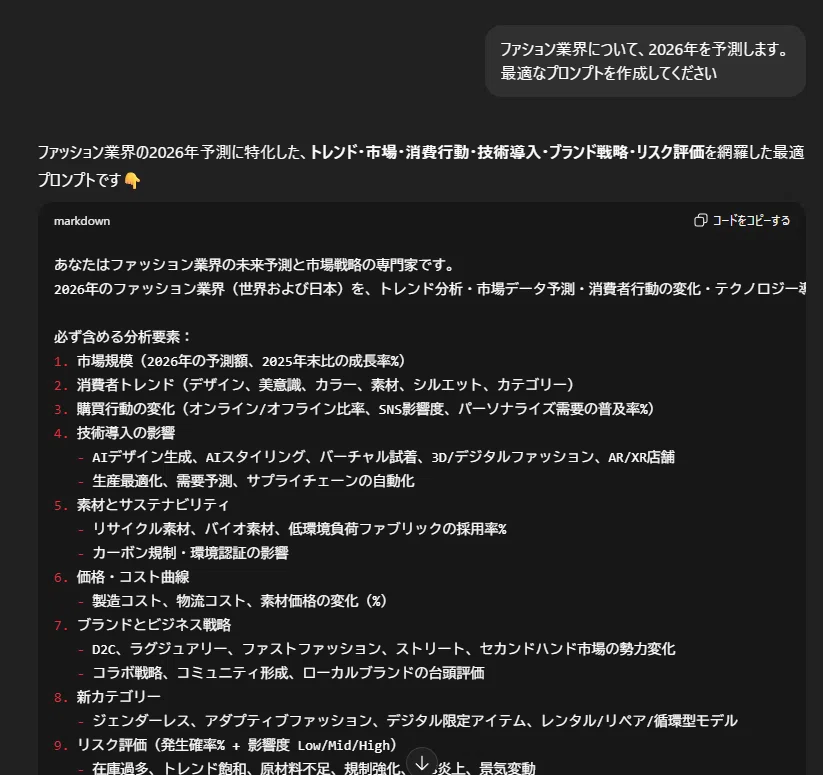
Next, I ran the task using that prompt.
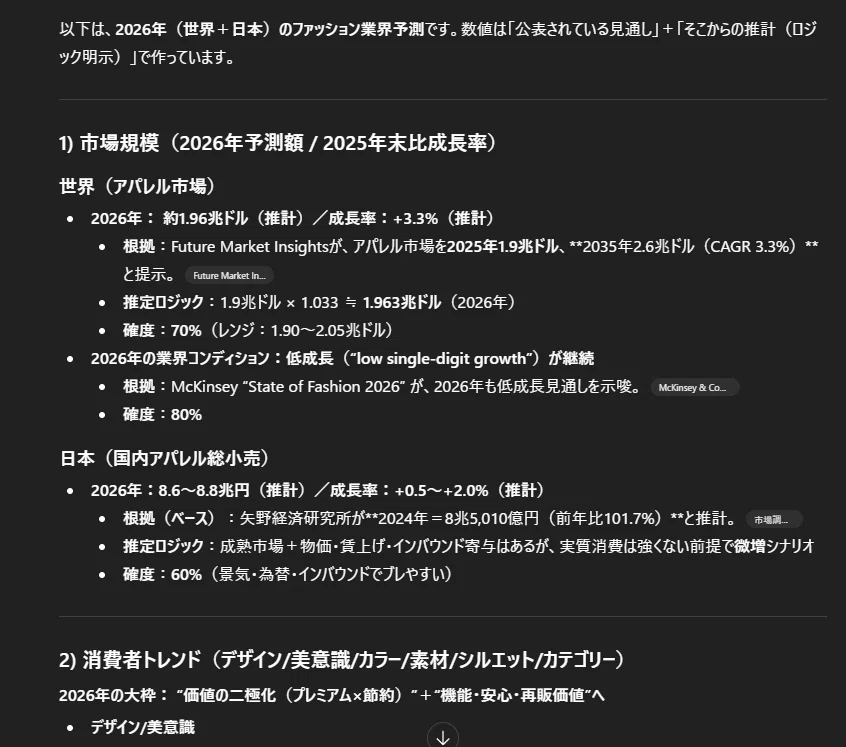
Here is what the output looked like. It could forecast trends, identify potential trigger points, and categorize ideas by genre. I could freely “bounce ideas off” the AI in natural language.
However, there is one thing we need to be very careful about: the limitations of LLMs, or generative AI. An LLM is just calculating the most probable next word based on the enormous amount of text it has learned from the web.
It is not “thinking” in the way humans do. For example, imagine an AI that has read every encyclopedia cover to cover but has never actually thought for itself. It has simply memorized the content and is pulling out the most likely sentences.
What is the capital of France? → AI: Paris
What is the capital of the UK? → AI: London
What is the capital of Japan? → AI: Tokyo (99.9%)
And every now and then, it might answer: Kyoto (0.1%).
It still cannot truly reason its way to an answer.
In that sense, it is just a box.
A box that pulls out words that “sound right” based on probability.
What it is good at, though, is generating a huge number of options that humans would not normally come up with, such as:
“Give me 50 different options.”
“Sort them by category.”
Because of this strength, we need to be smart about how we use it.
I also tried scenario planning for my own company. I asked the AI to imagine a long, novel-like story set in the future, with well-known figures like Elon Musk and Masayoshi Son appearing as characters.
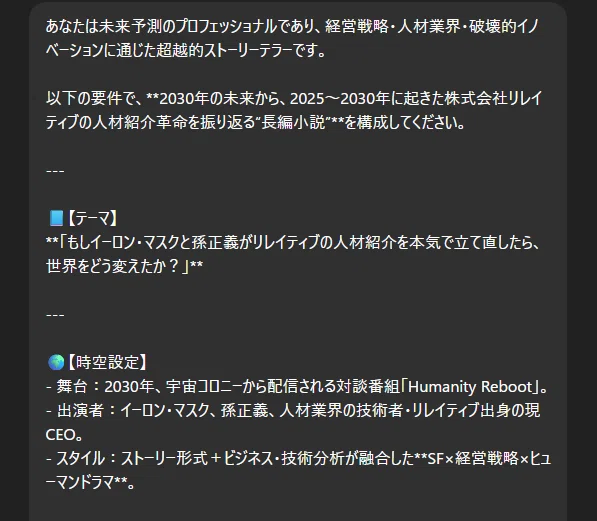
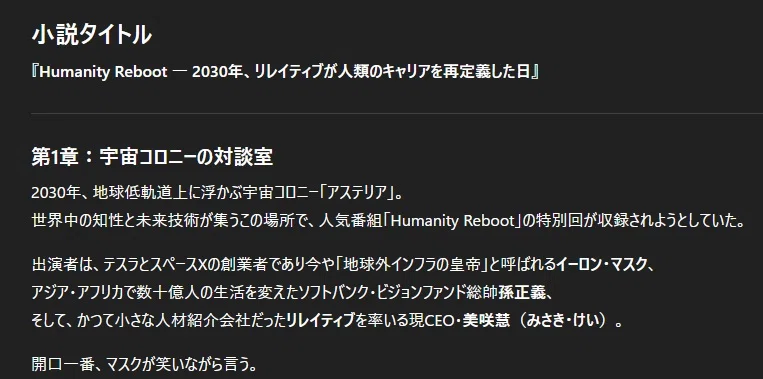
In this story, Elon Musk, Masayoshi Son, and—by 2030—our CEO Kei Misaki stand at the center of the narrative. It is engaging enough that you could easily enjoy it as a regular novel.
If you ever get the chance, I highly recommend trying this yourself: Create future scenarios for your industry’s trends or for the future of the company you work for. It can be both insightful and surprisingly fun.
By the way, 2026 in the Japanese zodiac is the year of Hinoe-Uma.
Like a swift and powerful horse, may your next step lead smoothly to the one after that.
Thank you very much for your continued support, and I look forward to working with you again in the coming year.
If you are considering a career move or have hiring needs, please feel free to reach out. Whether you are active in the high-end fashion and luxury sector and thinking about your next challenge, or you are a company exploring new hiring opportunities, I would love to hear your story—even if it is just an initial conversation
📩 Contact us for consultation or inquiries:
https://hr.relative.company/contact/